

Email Domain Analysis
Email Domain extracts and ranks the most frequently occurring email domains in selected email fields.
The Email Domain Analysis scans the values in selected email fields and extracts the domain portion of each address: everything after the @ sign. It then counts and ranks how often each domain occurs, showing which email providers and organizations are most represented in your data. Differences in upper and lower case are not taken into account.
Use the Email Domain Analysis to understand your provider mix (personal vs. corporate domains), spot concentration around specific customer or partner domains, and catch data quality issues like test or disposable domains.
Email Domain Analysis or Email Regex Validation?
Both Email Domain Analysis and Email Regex Validation run on email fields, but they answer different questions. The Email Domain Analysis ranks which domains occur most often in your data. Email Regex Validation instead checks whether each value is a syntactically valid email address at all. Use them together: Email Regex Validation to confirm addresses are well-formed, and Email Domain Analysis to understand who those addresses belong to.
Configuration
Because any text field can be used to store email addresses in, all available text fields are presented when creating a Plauti Context job with the Email Domain Analysis. It is recommended to disable the Email Domain Analysis type in Object Configuration for those fields that do not contain email addresses in your Org.
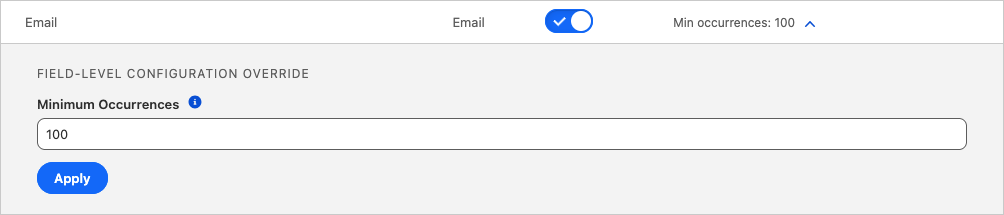
Based on your goal for the analysis, set a minimum occurrence threshold. Email domains that occur less often than the threshold are not displayed in the results.
Detailed Job Results
For each field an Email Domain Distribution doughnut chart is displayed, highlighting the top 5 domains and their relative volume, and the remaining domains grouped together in the Other section of the chart.
Below, each field section shows a Domains Above Threshold table containing all domains found in that email field that occur at least as often as the Minimum Occurrences threshold you configured for the analysis, along with the Count and Percentage share of records for each domain.
Key Insights
- Provider distribution: Shows the mix of personal domains (e.g.
gmail.com,outlook.com) versus corporate domains, indicating how much of the field is consumer versus business email. - Customer and partner concentration: Surfaces which corporate domains appear most often, useful for spotting key accounts with many associated contacts.
- Data quality issues: Flags test domains (e.g.
test.com,example.com) and disposable or throwaway providers (e.g.mailinator.com) that shouldn't be present on live records. - Domain concentration risk: Having one or a small number of domains making up an unusually large share of records can point to either a real business pattern, or a data quality issue worth investigating.
Recommended Actions
| Scenario | Actions |
|---|---|
| Many test domains or disposable domains | - Identify whether test emails are being entered by internal users or through a specific process. - Update training to discourage test/disposable addresses on live records. - Add validation or business rules to block known bad domains on production data. - Clean existing data, for example with Plauti Manipulate. |
| High share of personal vs. corporate domains | - Review the lead or account creation process for opportunities to capture corporate email addresses in B2B scenarios. - Use the distribution results to segment communications by B2B vs. B2C. |
| Concentrated on a few key customer domains | - Use the top domains to identify key customers or partners with many contacts. - Prioritize the top domains for cleanup or enrichment. Combine with Email Regex Validation to confirm address format, and a mailbox verification tool such as Plauti Verify to confirm mailbox existence. |
| Preparing data for AI or segmentation | - Treat test and disposable domains as low-quality signals to exclude.- Use domain information to build business vs. consumer segments. - Review domain distribution before major campaigns or before updating scoring/AI models. |