
Skip to content

How to Standardize Fields in Salesforce: A Step-by-Step Guide

  • Data quality
  • Salesforce
Close-up of code displayed on a dark monitor screen

Pull a quarterly report and ask how many leads came from the US. The dashboard answers back with United States, USA, U.S.A., US, America, and a few lowercase versions of each.

That's not a cosmetic problem. It skews report accuracy, breaks automations that match on exact values, and erodes trust in the numbers you present. Standardizing those fields fixes it: native Salesforce tools handle a good share of the work, and Plauti picks up the rest at scale, without leaving Salesforce.

Before you start, you'll need:

  • Salesforce admin permission
  • The target objects and fields (for example, Leads and Accounts; Country, State, Industry, Job Title, Phone)
  • Access to Setup and Object Manager
  • A sandbox for testing (optional, strongly recommended)
  • A backup plan for bulk updates — an export or snapshot before you touch live data

Four steps to standardize fields with native Salesforce tools

Step 1: Use picklists for consistent values

Convert free-text fields to picklists so users can only select approved values.

  • Setup > Object Manager > your object > Fields & Relationships.
  • Open the target field (for example, Country). If it's a text field, change the field type or create a new picklist field.
  • Add approved values — always "United States," never "USA."

Pro tip: use Global Value Sets to keep the same values consistent across objects.

Step 2: Add validation rules to block messy inputs

Stop bad formats at the point of entry.

  • Object Manager > your object > Validation Rules > New.
  • Create rules that enforce formats — phone number or postal code, for example.
  • To enforce E.164 phone format: NOT(REGEX(Phone, "^\+?[1-9]\d{1,14}$"))
  • Add a clear error message so users know what to enter.
  • Activate and test the rule.

Step 3: Use record-triggered flows to auto-correct common variations

Fix variations automatically as records are created or updated.

  • Setup > Flows > New Flow > record-triggered flow on your object.
  • Add decision elements to catch variants — "usa," "U.S.," "United States of America."
  • Use Update Records to set the standard value ("United States").
  • Test edge cases and capitalization, and keep a running list of new variants you find.

Step 4: Clean up existing data

Bring legacy records into alignment.

  • Option A: Data Loader or Data Import Wizard to export, clean with find/replace in a spreadsheet, and reimport.
  • Option B: build a Flow that loops through records and updates values in bulk.
  • Always back up before a bulk change, then spot-check the results with a report.

Where native tools stop scaling

Each step above works, but native Salesforce tools have real limits once the number of variants and records grows:

  • They only catch what you anticipated. "U-S-A" or "US of A" slips through unless someone has already coded for it.
  • They don't handle creative spelling, typos, or inconsistent capitalization gracefully.
  • They're maintenance-heavy. Every new variation means updating a Flow or a rule.
  • Bulk cleanup through export, spreadsheet, and reimport takes time and can go wrong.
  • Ongoing monitoring needs custom reports and regular audits.
  • The approach scales poorly as fields, objects, and teams grow.

Standardizing fields at scale with Plauti

The four steps above work, but they take time to build and more time to maintain — every new spelling variant is another Flow branch or validation rule. When you're maintaining this across dozens of fields and thousands of records, Plauti handles the bulk, repetitive work natively inside Salesforce.

What it does for standardizing fields

  • Find and replace at scale, normalizing thousands of records at once.
  • Mass Update across any object and any field, including custom fields.
  • Scheduled jobs that keep new data standardized as it comes in.
  • An Audit Log showing exactly what changed, when, and by whom.

It runs natively inside Salesforce, so there's no export, spreadsheet, or reimport step in the loop. For a team standardizing the same handful of fields every quarter, that removes the export-clean-import cycle entirely.

Setting up field standardization in 10 minutes

Step 0: Test in a sandbox

  • Install Plauti in a separate sandbox.
  • Run test operations on sample data.
  • Review the Audit Log and results.

Step 1: Install and prep (5 minutes)

  • Install from AppExchange.
  • Assign permission sets to admins and power users.
  • Open the Plauti app.

Step 2: Clean existing messy data (5 minutes)

In this example, the Country field gets standardized.
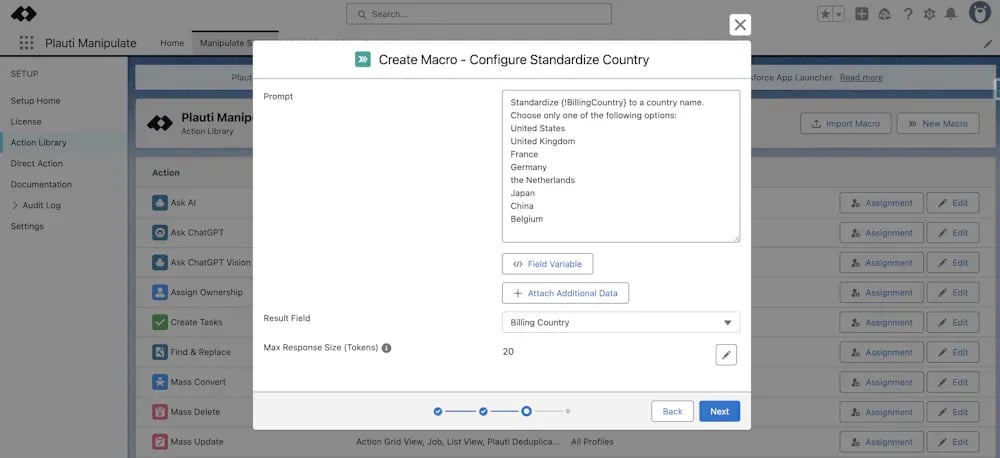
  • Create a macro with a prompt such as "Standardize {!BillingCountry} to a country name," and set the result field to Billing Country.
  • Run it and review the results in the Audit Log.

Before and after: what changes for admins

Before

  • Reports split across "USA," "United States," and more.
  • Weekend spreadsheet sessions to clean imports.
  • Automations misfiring on inconsistent values.

After

  • Clean, reliable reports and dashboards.
  • Bulk standardization done in minutes, inside Salesforce.
  • Confident exec meetings and smoother automation.

What one admin says about the before and after

Josh Flexen, Director of Marketing Operations at Pecan AI, explains why he chose Plauti.

More resources

Hungry for more?

Ready to take control?

With a product tour you can walk through the product yourself without installing anything, or book a demo for a guided look.