
Guides
What Is a Marketing Tech Stack?
A marketing tech stack is every tool that runs your marketing, sales, and support work: CRM, CMS, email, analytics. This chapter covers what belongs in one and why data quality decides its success.

Sales blames marketing for weak leads. Customer success can't get renewals because nobody handed off context from the deal. Both are symptoms of the same problem: siloed teams working from different — sometimes contradictory — data about the same customer.
This chapter covers why aligning sales, marketing, and customer success matters, and the five concrete steps to get there.

If you recognize either of those complaints, the disconnect usually traces back to a lack of shared visibility across teams. Better communication and a shared understanding of the customer journey let all three teams perform better, and make it easier for prospects and customers to navigate your product.
All three departments complement each other by design. Sales and marketing alignment drives revenue growth; customer success alignment keeps the customers that growth brings, so they renew and refer.
When the silos between sales, marketing, and customer success come down, the customer becomes the shared focus instead of a handoff between departments. Retention strategy, sales targets, and marketing campaigns start pulling from the same data instead of three separate spreadsheets. Here are five reasons that's worth the effort:
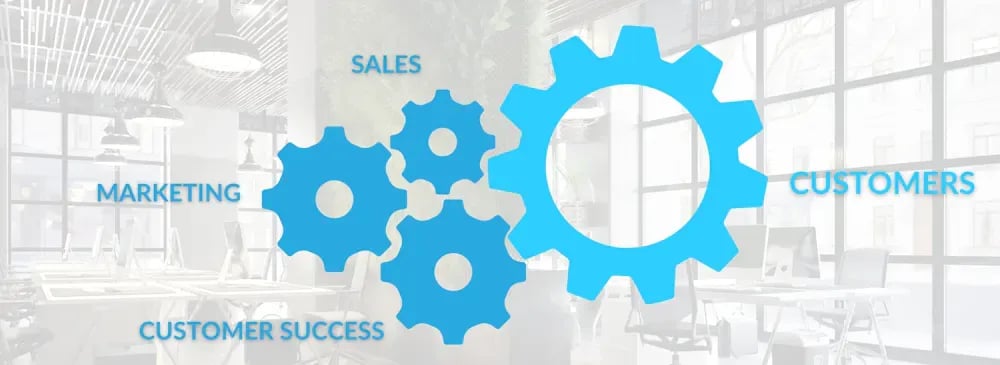
Teams working together close the gaps in a customer's journey — the moments where a handoff usually loses context. Customers notice when they don't have to repeat themselves to a new department.
A satisfied customer brings repeat business, referrals, and word-of-mouth marketing you didn't pay for. Misalignment works the other way: a confusing, disjointed experience costs you at renewal time, no matter how good your quarterly numbers looked before that point.
Working across teams surfaces patterns no single department sees alone — trends that inform product strategy and help you stay ahead of what the customer needs next, not just what they asked for last quarter.

Aligning these three teams is real work: each has its own goals, timelines, and success metrics, even though they're part of the same company. Marketing chases pipeline, customer success chases retention, and sales chases the close. Five practices bring them together:
Agree on one goal that ties back to overall business objectives, and put it in writing. A Service Level Agreement (SLA) between the teams spells out what each one owes the others — response times, handoff criteria, reporting cadence — so nobody has to guess.
Set a recurring meeting across the three teams and a standard channel for updates, so a change in one team's plan reaches the other two before it becomes a surprise.
Sales, marketing, and customer success should describe products, tools, and customer stages the same way. A shared glossary of terms, plus training on it, keeps three teams from measuring the same thing three different ways.
Build customer segments together — by size, industry, location, or product — so a lead marketing scored as "high value" means the same thing to sales and to customer success.
Review campaign and program results as a group, not in three separate reports. What one team learns about why customers churn should change what the other two do next.
Sales, marketing, and customer success don't have to work at odds. Aligning them takes shared goals, consistent communication channels, one shared vocabulary, and segmentation work all three teams use. Do those four things, and the customer experience holds together across every handoff.
Guides
A marketing tech stack is every tool that runs your marketing, sales, and support work: CRM, CMS, email, analytics. This chapter covers what belongs in one and why data quality decides its success.
Guides
A tech stack audit finds which tools earn their subscription, which duplicate each other, and where your data quietly drifts out of sync. Seven steps, from setting goals to acting on the results.
Alignment is crucial for creating a unified customer experience, improving satisfaction, and increasing revenue. When these teams share data and work together, customer needs stay prioritized throughout the whole journey, from first contact through repeat purchases and referrals. That leads to more effective marketing, more efficient sales processes, and better retention.
Alignment involves defining shared goals, maintaining regular communication, establishing a common vocabulary, collaborating on customer segmentation, and regularly analyzing and optimizing strategies together. Following these steps keeps all three teams working toward the same objectives instead of three separate ones.
Aligning these teams brings a better customer experience, deeper customer insight, and more revenue. It gives customers one consistent experience from awareness through purchase to loyalty, with more efficient use of resources and better targeting than three teams working independently.
The main challenges are differing goals and metrics, different timelines and resources, and no shared vocabulary between teams. Overcoming them takes deliberate work: defining shared goals, improving communication, and building a common understanding of the customer's needs and journey.
A Service Level Agreement to define shared goals, regular cross-team communication, a shared glossary of terms, joint work on customer segmentation, and ongoing review of campaign results together all help keep the three teams coordinated and moving toward the same outcomes.
With a product tour you can walk through the product yourself without installing anything, or book a demo for a guided look.