Skip to content

What Is a Marketing Tech Stack?

  • Data quality
Stacked green 3D geometric blocks illustrating the layers of a technology stack.

A marketing tech stack is the collection of software your team uses to run marketing, sales, and customer support — automation platforms, a CRM, analytics, social tools, and a CMS, wired together. Get the stack right and each tool feeds clean, connected data to the next. Get it wrong, and the same customer record splinters across five systems that never agree.

This chapter opens a guide to building and maintaining a marketing tech stack. It covers what a stack is made of, why the right one matters, and why data quality determines whether any of it works.

Why does your tech stack matter?

The tools you pick decide how fast your team can store, share, and act on customer information. A well-matched stack lets marketers focus on strategy instead of manual data entry; the wrong one adds friction to every campaign and every handoff to sales.

Two questions are worth asking before you go further:

  • Do you have control over your company's martech stack?
  • Do you even have one, formally?

If the answer to either is no, treat that as the priority. Without a deliberate stack, your revenue team works with whatever tools happened to get bought over the years — and closes fewer deals because of it.

What's in a marketing tech stack?

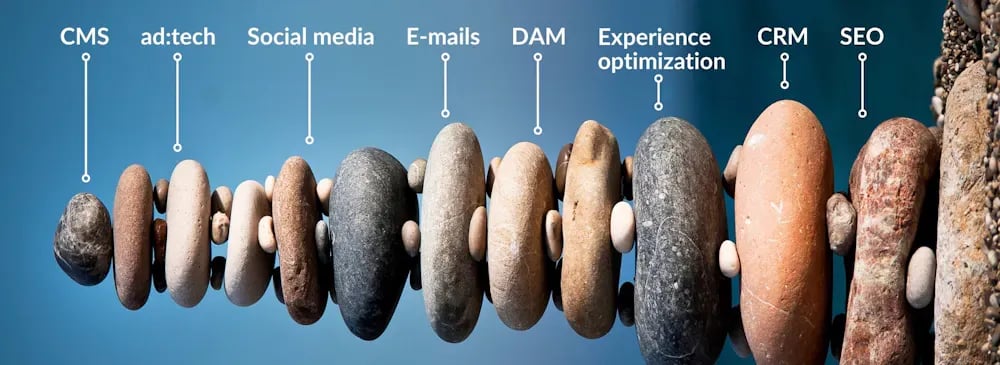
Not every stack needs all of these, but most B2B teams end up with some version of each:

  • Content management system (CMS): stores and publishes your website content.
  • Advertising technology (ad:tech): the banners, tag managers, ad exchanges, and networks behind paid campaigns.
  • Social media tools: scheduling, analytics, and audience targeting for social channels.
  • Email: direct outreach, automation, and list segmentation.
  • Digital asset management (DAM): a shared library for images, video, and documents, so teams reuse assets instead of recreating them.
  • Experience optimization: A/B testing and personalization tools that act on your analytics.
  • CRM: the system of record for customer data, sales, and support interactions.
  • SEO tools: track and improve organic search visibility.

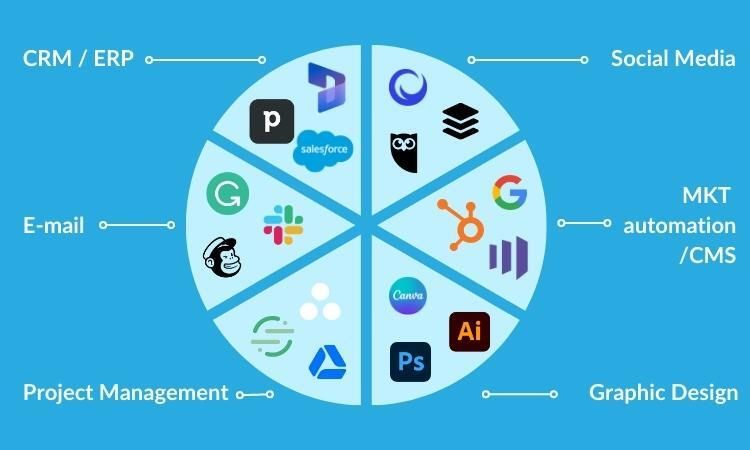
The compatibility between these tools matters more than any one of them alone. If you're standardizing on a CRM — Salesforce is the most common choice for B2B teams — every other tool in the stack needs a clear, defined way to pass data in and out of it. Map that data flow before you buy, not after: retrofitting integrations onto five already-purchased tools costs far more than picking compatible ones up front.

Why does data quality matter more than the tools themselves?

None of the tools above are useful if the data moving through them is wrong. Data quality measures how accurate, complete, and fit for purpose your records are — and it's the hardest thing to keep healthy as a company grows, because more people, more processes, and more integrations all create more chances for records to drift out of sync.

In a 2021 report, Experian found that 95% of business leaders had seen a negative business impact from poor data quality — lost customer trust, damaged experiences, or decisions made on bad information. A stack full of well-chosen tools still fails if what flows between them is duplicate, outdated, or incomplete.

How do you build a marketing tech stack?

Building your stack is less about picking the flashiest tools and more about matching tools to a plan. Five steps get you there:

  1. Identify your strategy and goals. List what you're trying to achieve — more organic traffic, faster lead response, better retention — before you look at a single tool. For each goal, note the strategy behind it and the tools that could support it: a goal to increase organic traffic, for example, pairs with an SEO strategy and a tool like SEMrush. Survey the people doing the work day to day; they know where the current process breaks.
  2. Set a budget. Decide whether you're paying annually or monthly, how many seats you need, and whether a shared subscription covers your team. Budget by tool or by strategy, whichever maps more cleanly to your goals.
  3. Research your options. Have the people who'll use each tool daily compare price, features, and durability in a shared spreadsheet, not just a sales deck.
  4. Prepare your data for transfer. Assign an owner for each data type — contacts, leads, templates, creative — and a workflow owner per tool, before you start moving anything.
  5. Evaluate and readjust. Audit the stack again after it's been running for a while. Cancel, renew, or replace individual tools as your needs change — treat the stack as something you maintain, not something you finish.

Once it's running, revisit auditing your stack on a schedule so it doesn't drift back into a pile of redundant tools.

Hungry for more?

  • Stacked green 3D geometric blocks illustrating the layers of a technology stack.

    Guides

    7 Steps to Audit Your Marketing Tech Stack

    A tech stack audit finds which tools earn their subscription, which duplicate each other, and where your data quietly drifts out of sync. Seven steps, from setting goals to acting on the results.

Frequently asked questions

What is a marketing tech stack?

A marketing tech stack is the set of technology tools marketers use to run and measure their work, including systems for automation, content management, social media, email, digital asset management, CRM, and SEO. The right combination lets a team understand customer needs, track market trends, and execute campaigns without duplicating effort.

Why does a marketing tech stack matter?

It determines how efficiently your team works. A well-matched stack cuts the time and cost of running campaigns and gives marketers accurate performance data to act on. It also scales with the business, since small teams and large ones both rely on connected tools to execute their strategy.

What are the components of a marketing tech stack?

The typical components are a content management system (CMS) for the website, advertising technology for paid campaigns, social media platforms, email tools, digital asset management (DAM) for creative files, experience optimization tools for testing and personalization, a CRM for customer data, and SEO tools for organic visibility.

How does poor data quality affect a business?

Poor data quality causes lost customer trust, damaged customer experiences, and decisions made on incomplete information. A 2021 Experian report found 95% of business leaders had seen a negative business impact from it. It also raises operational costs, since teams spend time reconciling records that should have matched in the first place.

How do you build a marketing tech stack?

Start by defining your strategy and goals, then set a budget, research tool options against your specific requirements, plan how data will transfer into each new tool, and revisit the stack periodically to retire or replace what no longer fits. Treat it as an ongoing process, not a one-time purchase.


Ready to take control?

With a product tour you can walk through the product yourself without installing anything, or book a demo for a guided look.