Skip to content

From rules to intelligence: The next step in deduplication

  • Salesforce
  • Deduplication
  • Automation
Illustration of merging duplicate customer records guided by AI recommendations.

Deduplication has always been about trust. Users want clean data, and they want to know how it got that way. For years, Plauti has relied on mathematical rules to merge records automatically: keep the most recently updated record, keep the field with the longest string, or take the value that appears most often. When a requirement falls outside those rules, an admin can write custom logic with Plauti's SDK. These rules are clear and predictable, but they can't judge context.

The Evolution of Deduplication

Mathematical rules gave deduplication a solid foundation. They let admins configure deterministic outcomes: the same inputs always produce the same merge, so nothing about the result is a surprise. That predictability is what made automated merging safe to turn on in the first place.

The Limits of Purely Mathematical Rules

Real-world data is messy, and rules alone can't judge quality. The most recently updated record isn't always the most accurate one, and sometimes what matters is the type of information, not its age. Keeping a business email over a personal one in the master record's main email field is a judgment call: a rule has no way to know which email is which kind. AI can read that context and decide which value belongs in the master record. That's the shift: deduplication moves from strict rule-following toward informed data stewardship.

Where AI Adds Value

AI adds flexibility instead of applying one rule to every case. It can look at a set of duplicate records as a whole, catching patterns a fixed rule would miss, and propose merges closer to human judgment. For example, it can infer the correct spelling of a first name from the email address on the same record. The result is fewer manual checks and a faster review of what's left.

Balancing Trust and Control

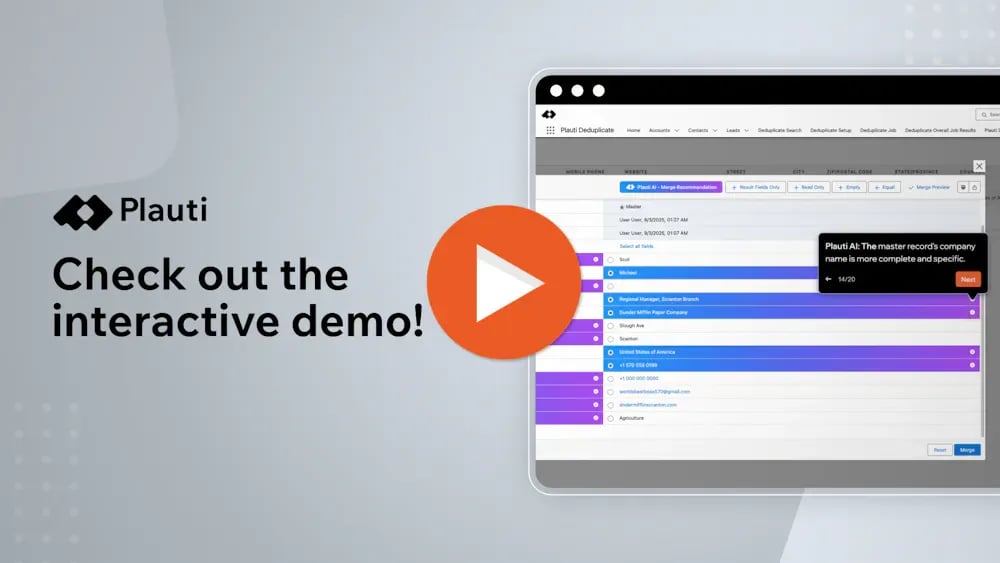
AI Merge Recommendations never override your rules and never merge on their own; they suggest, and an admin still makes the final call. You choose which fields get an AI recommendation at all, field by field, so a rule and an AI suggestion can sit side by side. Use a rule where you want a deterministic outcome and AI where context matters more. For example, an admin might keep a simple rule for account ownership, using the earliest created date, while letting AI judge which job title to keep in the master record when a duplicate has more than one on file.

What Happens to My Data?

When you enable AI Merge Recommendations, Plauti sends the relevant record data to a third-party AI provider over a secure connection. The provider analyzes the selected records together and returns field-by-field recommendations. It does not store or persist your data outside your environment.

Using the feature requires signing a Data Processing Agreement (DPA), which sets out that the data handling is lawful, transparent, secure, and compliant with applicable privacy laws. Access is limited to organizations that have signed the DPA. Every AI suggestion stays visible for review, and nothing changes in your data until you confirm it.

The Future of Smart Deduplication

AI Merge Recommendations are a first step. Plauti plans to extend them from proposals into automation, so clean data needs less manual work over time.

Hungry for more?

Ready to take control?

With a product tour you can walk through the product yourself without installing anything, or book a demo for a guided look.