Control
Nothing merges unless it clears the threshold you set.
- Tune it per object and per channel.
API writes, data loads and integrations get the same rules as manual entry. Clear duplicates merge; the rest queue for review.
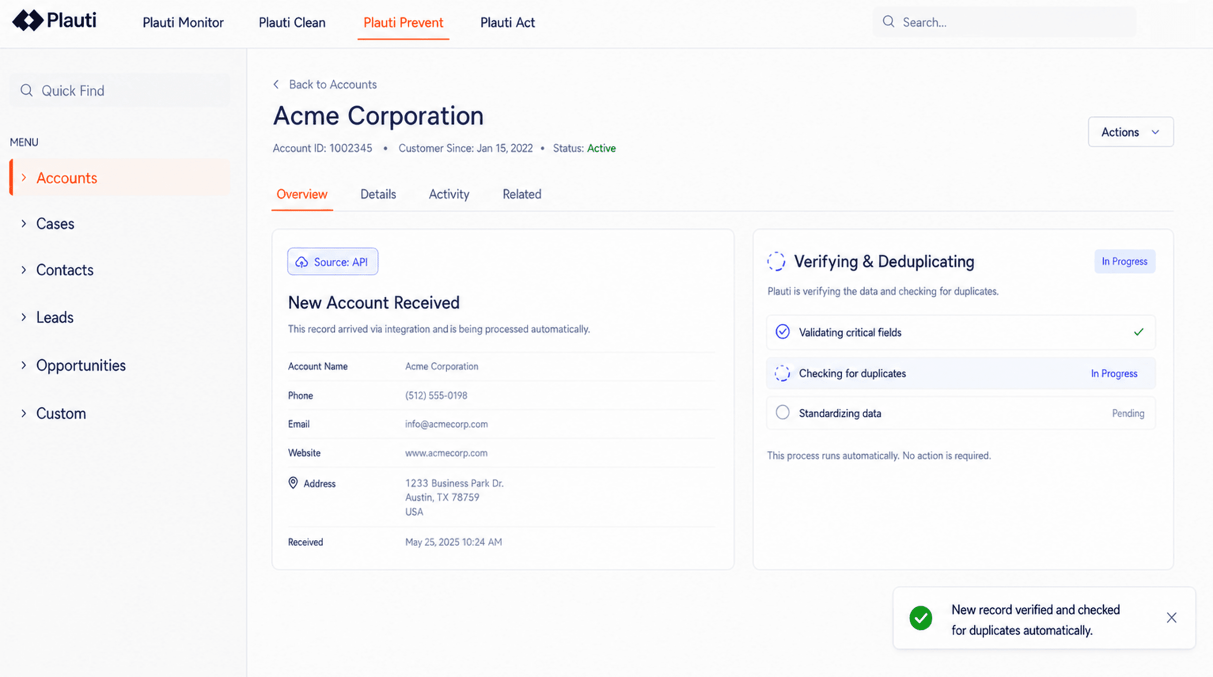
Enabled per object, per channel. One score decides what happens next.
API inserts and updates, bulk loads, flows and your own code. Each one switched on per object.
High-confidence duplicates are resolved during the import run itself. What is left collects in one review job, instead of spreading through the object unnoticed.
The incoming record merges into the existing one, following your merge rules. 95% is a common starting point, and any merge can be reversed.
The record is still written. The match waits in a review job — one per object, which every later match is added to.
The four things admins check before letting anything merge on its own.
Nothing merges unless it clears the threshold you set.
An incoming record can carry new consent or activity, so it is always written.
A single job can cover millions of records.
It extends the rules you already run.
No. The insert always succeeds and the calling system gets no error back, so nothing upstream breaks. What changes is what happens to the duplicate afterwards.
Manual entry and web forms can warn a person or block the save. An automated write has nobody to warn, so the same scenarios end in a merge or a queue.
Yes. Leave automatic merging off and detection still runs: every match goes to a queue and each merge stays a person's decision.
In the platform, on a local machine, on your own server, or in the cloud. The rules are the same in each; only the engine changes. That is how a job covering millions of records stays clear of your platform limits.
Talk with one of our experts to see how that works for your use case.