
Case studies
How Xerox Improved Global Data Integrity in Salesforce
Xerox's global CRM team cleaned up cross-team duplicate records in Salesforce, then added prevention so marketing targeting and client reporting stay accurate as the company scales.

Customer expectations have risen. People expect a brand to already understand what they want, and a business that treats every customer the same way risks losing both engagement and the sale.
For CRM managers, customer experience teams, and marketing professionals, the task is to use the data already sitting in the CRM to build experiences that fit each customer's situation. Two strategies make that possible: segmentation and personalization.
This article covers both — how to build customer segments, how to personalize on top of them, and what changes when the underlying data is accurate.
Segmentation divides a customer base into groups defined by a shared trait — demographics, behavior, psychographics, or geography. Personalization uses that grouping, or a single customer's own data, to shape what each person sees or hears. Segmentation decides who to group; personalization decides what to say to each group.
A sales team, for example, might segment by territory — EMEA, APAC — then personalize further within EMEA by role: marketing, sales, IT.
Hyper-personalization can improve the customer experience, but it takes real time and tooling to build and maintain. Match the level of personalization to what your team can sustain rather than to what's technically possible.
Segmentation and personalization pay off, but each comes with a cost:
| Aspect | Pros | Cons |
|---|---|---|
| Personalized messages | Raise relevance and engagement | Take time to write for every segment |
| Customer experience | Improves | Only after detailed data analysis |
| Targeted campaigns | Convert better | Add complexity to campaign management |
| Resource allocation | Gets sharper | Usually needs more tooling or staff |
| Data use | Gets more value from what you already collect | Risks collecting more than you can act on |
| Segment definitions | Map more clearly to real needs | Need ongoing upkeep as behavior changes |
| Return on investment | Tends to rise | Setup costs — tools, training, consultants — come first |
| Brand loyalty | Deepens within a segment | A message aimed too narrowly can alienate everyone outside it |
| Scalability | Holds up only if the workload scales with it | Segmentation done by hand does not |
Segmentation is the first step toward a more customer-centric approach: without groups to work from, personalization has no target. Grouping is really a form of useful stereotyping — dividing a broad customer base into smaller, more predictable groups you can act on.
The types below are the common starting points; some will already be familiar, others may not.
Each type below groups customers by a different kind of trait. Together they cover most of what a CRM already records about a customer, directly or indirectly.
Groups customers by quantifiable traits — age, gender, income, education, occupation. Use it to match products and messaging to a population segment: trendy items for younger buyers, premium goods for higher-income ones.
Groups customers by what they do — purchase frequency, brand loyalty, product usage, benefits sought. Use it to act on a pattern already visible in the data: a loyalty discount for repeat buyers, a first-purchase offer for new ones.
Groups customers by psychological traits — lifestyle, personality, values, social status. It's harder to measure than the other types, because none of it comes from a transaction record, but it lets a brand connect on values rather than behavior alone.
Groups customers by physical location — country, city, climate, population density. Use it to adjust pricing, offers, or messaging for regional preference, culture, or climate.
Groups customers by the technology they use — devices, software, platforms. A customer who only ever opens your emails on mobile is a technographic segment of one.
A B2B counterpart to demographic segmentation: groups businesses by company size, industry, revenue, or location. Use it to route an enterprise account to a complex solution and a small business to a cheaper one.
Groups customers by the specific problem they're trying to solve with your product. Use it to match a solution to a stated need rather than a demographic guess.
Groups customers by the value they bring to the business — usually profitability or lifetime value. Use it to direct premium service and retention effort at the accounts that are actually worth retaining.
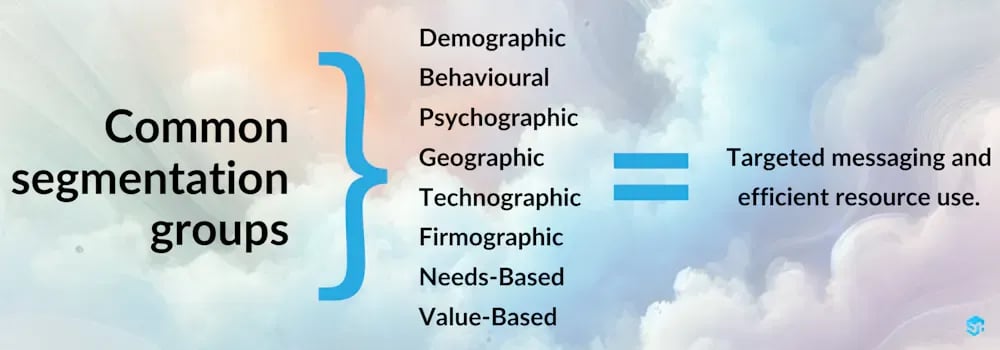
By understanding these segments, marketing and sales teams can craft messaging that's more likely to land with the audience it's aimed at. Segmentation puts the budget behind the groups worth the effort instead of spreading it evenly across everyone.
Once segments exist, personalization is what makes each interaction feel specific to that person rather than to the segment as a whole. That's a harder bar than it sounds: a message built for a segment of thousands still needs to read like it was written for one person. Customers now expect that; it's no longer a differentiator.
Email campaigns and product recommendations built this way create a stronger relationship with the customer than a one-size-fits-all message ever will.
Segmentation without personalization stops at knowing the group; personalization without segmentation has no group to build from. Used together, one feeds the other: a CRM team might segment by purchase history, then personalize product recommendations for the frequent buyers within it. A customer experience team might segment by cart-abandonment behavior, then send a personalized incentive to that group specifically.
Both depend on the data underneath them. Records that are outdated, duplicated, or missing a field misdirect the segment before personalization ever gets a chance.
Two steps come before either strategy earns its name:
Data collection and analysis. Segmentation and personalization run on the data underneath them, so keep it accurate, complete, and current — automate the cleanup rather than doing it by hand, and collect both demographic and behavioral data rather than one or the other.
Creating customer segments. Once the data is in shape, look for the patterns that define an actionable segment: a purchase frequency threshold, an engagement rate, a needs cluster. Revisit those segments on a schedule, because customer behavior moves and a segment built a year ago may no longer match who's in it.
Each channel below personalizes on a different signal — segment, behavior, or location.
Effective email marketing goes beyond a first name in the subject line:
Website personalization adjusts what a visitor sees in real time:
Relevant recommendations drive conversion in e-commerce:
Automation is what makes personalization possible past a handful of customers:
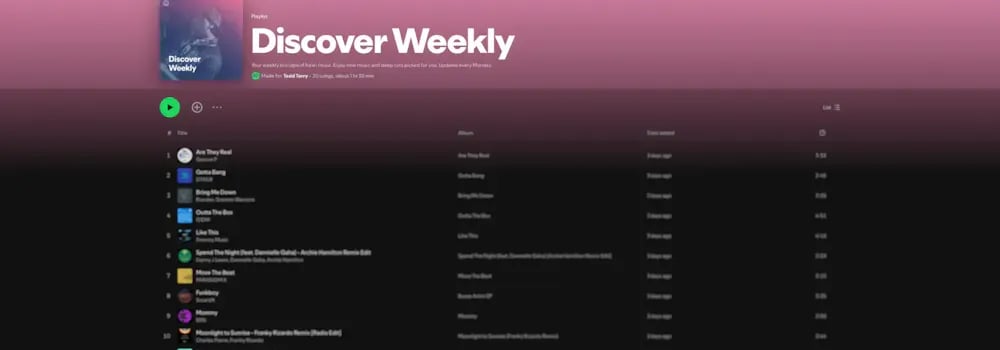
Discover Weekly is Spotify's clearest example of segmentation and personalization working together: listening data trains a model, the model segments listeners by taste, and each listener gets a playlist built from that segment plus their own history.
Spotify reports that over 60% of the songs it recommended through the feature were actually listened to. Within a year of launching Discover Weekly, more than 40 million users were engaging with it — a result Spotify attributes to higher customer satisfaction and a lift in free-to-premium conversion. The mechanism is the same one this article has covered throughout: segment first, then personalize on top of the segment.
Three metrics tell you whether segmentation and personalization are actually working:
One company that used Plauti to verify and standardize its customer data saw a 20% increase in engagement and a 15% boost in conversion, from a more targeted, personalized marketing approach built on cleaner data.
Segmentation tells you who you're talking to. Personalization decides what you say to them. Skip the first and personalization has no target; skip the second and segmentation stops at a list of names.
Both run on the same input: the same records, kept clean and current. A segment built on duplicate or outdated data misdirects the message before personalization ever gets a chance to help.
Case studies
Xerox's global CRM team cleaned up cross-team duplicate records in Salesforce, then added prevention so marketing targeting and client reporting stay accurate as the company scales.

Blog
Duplicate detection workarounds on Dynamics 365 CE migrations often go unscoped, and the hours come straight out of a boutique practice's margin. Here's what a year of engagements actually costs.
With a product tour you can walk through the product yourself without installing anything, or book a demo for a guided look.